
A Guide to AI Proofreading for New Authors
Polishing your book for publication doesn't have to be a solo struggle. Discover how AI proofreading can help you catch typos and improve clarity while keeping your unique author voice intact.
8 July 2026 · Updated 30 July 2026 · 6 min read
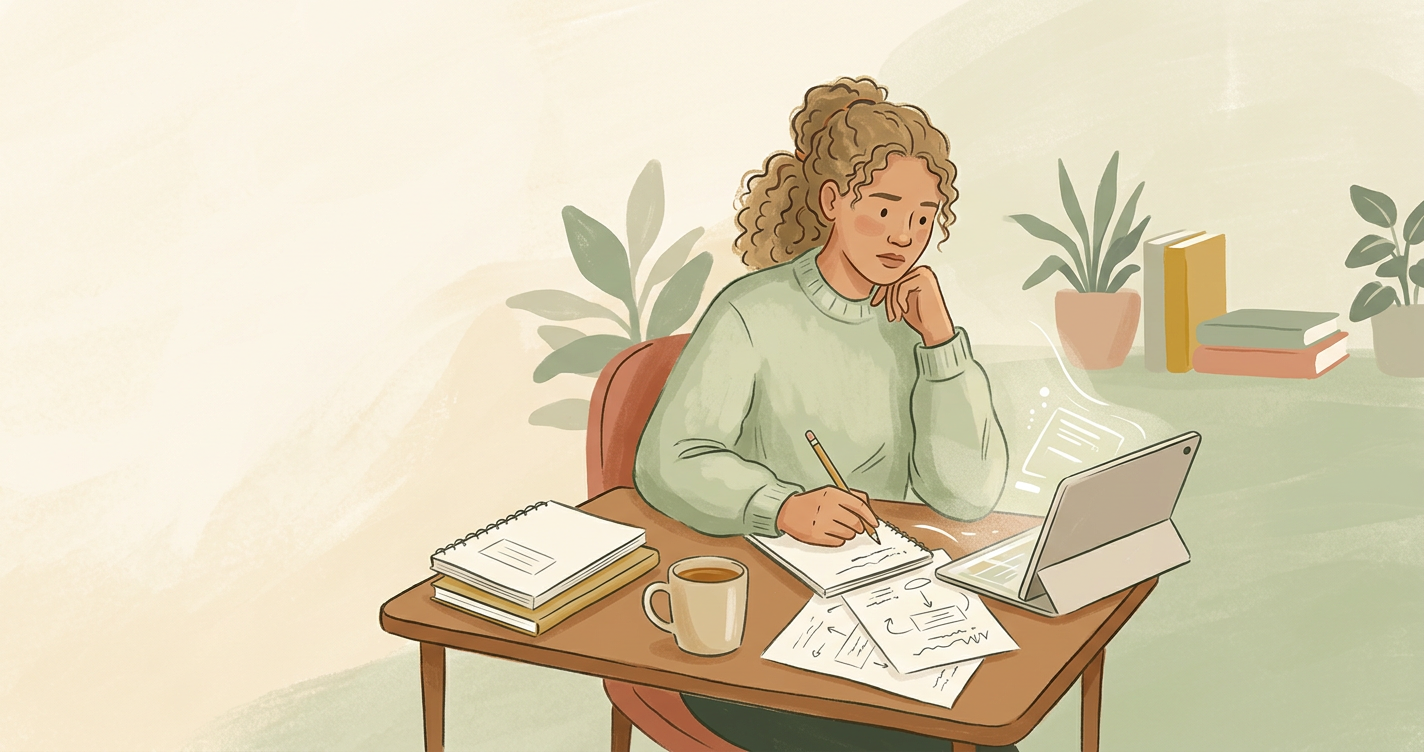
Finishing a first draft is a significant achievement, but the work isn't over until the manuscript is polished. For many writers, the transition from drafting to refining is where the real work begins. This is where AI proofreading can be a valuable companion, acting as a tireless second set of eyes that never suffers from fatigue, no matter how many thousands of words you feed it.
What is AI proofreading?
AI proofreading involves using software powered by large language models to scan your text for technical errors. Unlike basic spellcheckers, which simply compare words against a dictionary, these tools understand context. They can spot the difference between 'their', 'there', and 'they're' even when the word is spelled correctly, and they can suggest improvements to sentence flow and tone by analysing the relationship between words in a sentence.
Modern AI tools use natural language processing (NLP) to identify patterns. For example, if you describe a character’s eyes as 'blue' in chapter one and 'green' in chapter four, sophisticated AI can sometimes flag this inconsistency. It moves beyond simple mechanics into the realm of stylistic consistency, helping you maintain a professional standard throughout your entire manuscript.
How AI supports your editing process
When you are deep into ai writing or manual drafting, it is easy to become 'word blind'. You see what you intended to write rather than what is actually on the page. Your brain automatically fills in missing words and ignores repeated ones because it knows the story so well. AI doesn't have this bias. It treats every word with the same level of scrutiny. It can help with:
- Consistency: Ensuring you haven't switched between British and American spellings (such as 'colour' vs 'color') midway through a chapter.
- Clarity: Identifying long, rambling sentences that might confuse a reader. AI often highlights 'nominalisations'—where verbs are turned into clunky nouns—and suggests punchier alternatives.
- Grammar and Punctuation: Catching missing commas, incorrect tense shifts, or the dreaded 'dangling modifier' that can make a sentence unintentionally hilarious.
- Pacing and Rhythm: Some tools can analyse sentence length variety. If every sentence in your action scene is 25 words long, the AI can flag this, suggesting you shorten them to increase the tension.
The Step-by-Step AI Proofreading Workflow
To get the most out of these tools, it is best to follow a structured process rather than trying to fix everything in one go:
- The Macro Sweep: Run your full manuscript through the AI to catch low-hanging fruit like double spaces, missing full stops, and basic typos.
- The Style Check: Focus on 'crutch words'. We all have them—words like 'just', 'very', 'really', or 'suddenly' that we lean on too heavily. AI can provide a frequency report, showing you exactly where you’ve overused them.
- The Dialogue Audit: Review the AI's suggestions for dialogue carefully. This is where you will likely reject the most suggestions to keep your characters sounding authentic.
- The Final Polish: After accepting or rejecting changes, read the text aloud. If the AI-influenced version sounds natural to your ear, it’s ready.
Maintaining your voice
A common concern is that technology might make your writing feel robotic. However, the best approach to editing and proofreading is to treat AI suggestions as a menu, not a mandate. You remain the final editor. If an AI suggests a change that removes your unique flair, you simply decline it. AI is there to support the author, not replace them.
"The goal of proofreading is not to achieve 'perfect' English, but to achieve perfect communication between the author and the reader. Sometimes, that means breaking the rules on purpose."
For instance, if you are writing a noir thriller, you might use short, fragmentary sentences. An AI might flag these as 'incomplete sentences'. In this case, your creative choice overrides the technical rule. The AI has done its job by alerting you, and you have done yours by deciding the fragment serves the story.
Common mistakes to avoid
While helpful, AI tools have limitations. Even the most advanced models lack human lived experience and emotional nuance. Avoid these pitfalls:
- Over-reliance: Never assume the AI is 100% correct. It can occasionally misinterpret creative metaphors or niche jargon. If you use a technical term related to a specific hobby or profession, the AI might try to 'correct' it to a more common, but incorrect, word.
- Ignoring Context: In fiction, characters often speak with poor grammar, use slang, or have distinct regional accents. An AI might try to 'fix' this dialogue, which would ruin the characterisation. Always protect your dialogue from being 'sanitised'.
- Homonym Confusion: While AI is better than spellcheck, it can still struggle with rare homonyms or names that are also common nouns. If your protagonist is named 'Hunter', the AI might occasionally get confused if the context involves actual hunting.
- Skipping the Final Read: Always perform a final read-through yourself or with a human proofreader after using AI tools. A human can spot if a paragraph feels 'off' emotionally, something AI still struggles to quantify.
A Checklist for AI Proofreading
Before you hit 'accept all' on any AI suggestions, run through this quick checklist:
- Does this change alter the meaning of my sentence?
- Does this suggestion sound like something my character would actually say?
- Is the AI trying to turn my 'active voice' into 'passive voice' (or vice versa) in a way that weakens the prose?
- Have I checked that the AI hasn't introduced new errors while trying to fix old ones?
Preparing for publication
Once your manuscript is clean, you can move on to typesetting and formatting. A well-proofread book is much easier to format because you won't be stopping to fix typos during the design stage. When you are looking at a professional layout, every 'widow' and 'orphan' (stray lines at the top or bottom of a page) matters. Having the text finalised means you won't disrupt the layout with late-stage edits.
This preparation is essential before you begin the publishing process on KDP. Amazon’s Kindle Direct Publishing platform is highly accessible, but readers are quick to leave negative reviews if a book is riddled with basic spelling mistakes. Using AI proofreading is a cost-effective way to ensure your debut meets the expectations of a paying audience, protecting your reputation as an author from day one.
How There's a Book in Everyone helps
Our platform integrates sophisticated tools to help you refine your manuscript. From the initial book structure to the final checks, we provide the support you need to produce a professional-quality book. Our AI-powered editing features are designed to catch the small details so you can focus on the big picture of your story.
We believe that every author deserves a polished finish. Our tools don't just look for errors; they help you understand why a suggestion is being made. This educational aspect helps you become a stronger writer with every chapter you complete. By highlighting repetitive sentence starters or overused adjectives, our platform acts as a writing coach as much as a proofreader.
Concrete Examples of AI Improvements
To understand the value of AI proofreading, consider these common 'before and after' scenarios:
Example 1: The Wordy Sentence
Original: "He was really very hungry so he decided that he would go to the shops in order to buy some bread."
AI Suggestion: "Starving, he went to the shops to buy bread."
Result: The AI removed four 'filler' words, creating a more direct and engaging sentence.
Example 2: The Tense Slip
Original: "She walks into the room and sat down on the sofa."
AI Suggestion: "She walked into the room and sat down on the sofa."
Result: The AI identified a mismatch between the present tense ('walks') and past tense ('sat'), ensuring grammatical consistency.
Explore Editing Support
Ready to improve your manuscript? Use AI-powered editing and proofreading support to strengthen your book before publishing. By combining your creative vision with the technical precision of AI, you can ensure your message reaches your readers clearly and professionally.
Frequently asked questions
Ready to strengthen your manuscript?
Use editing and proofreading support to polish your draft before publishing.